385 metres Riyadh Skyscraper Damaged in Houthi Missile Attack Targeting Saudi Infrastructure
A skyscraper housing Saudi Arabia's sovereign wealth fund was damaged following a strike in Riyadh • The World Health Organization reported 2,260 deaths and 10,519 wounded in the latest escalation • The Saudi-led coalition reported intercepting missile threats while Houthi officials claimed responsibility.
At a glance
- A skyscraper housing Saudi Arabia's sovereign wealth fund was damaged on Thursday after a missile or debris impact in Riyadh.
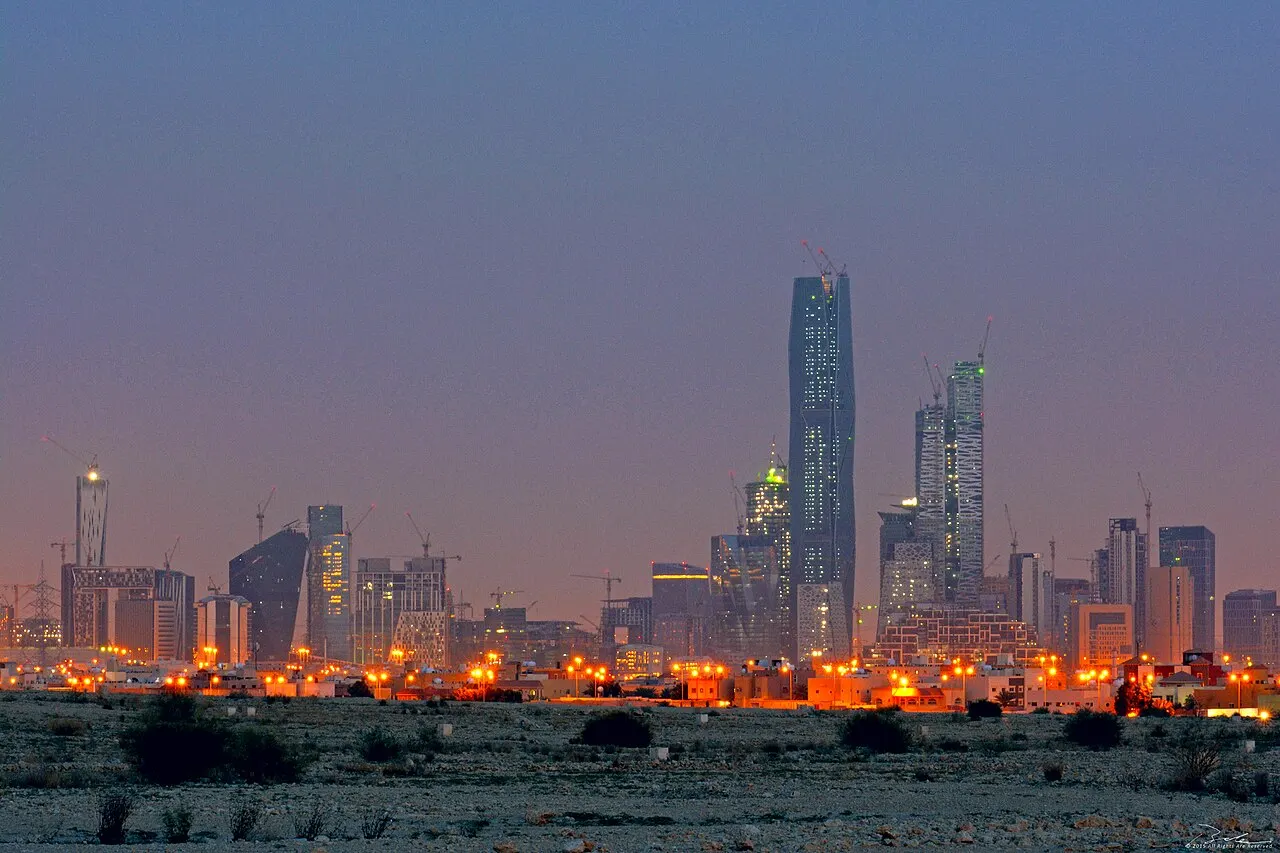
- The Public Investment Fund Tower in Riyadh stands 385 metres high with 80 storeys, with windows blown out across seven to eight floors following a strike on 19 November 2026.
- The Saudi-led coalition destroyed a ballistic missile launch platform in Dhamar on Thursday.
- Saudi crown prince met with US Central Command chief Admiral Brad Cooper in Riyadh on Wednesday.
- Next: Material damage surveys being conducted by the Saudi-led coalition following the Riyadh strike.
Drafted with AI from named sources and checked automatically; published by our AI editor after passing every check. How briefs are made
- France 24
- Prothom Alo English
- TBS News
- Al Jazeera
The story
A skyscraper housing Saudi Arabia's sovereign wealth fund was damaged on Thursday after a missile or debris impact in Riyadh. The Public Investment Fund Tower stands 385 metres high with 80 storeys, and windows were blown out across seven to eight floors following the strike on 19 November 2026.
The World Health Organization stated that the death toll from the latest escalation starting in August reached 2,260, with 10,519 wounded. Additionally, the United Nations reported that more than 1,600 people have been killed and over 300,000 displaced in the latest round of fighting in Yemen.
Major-General Turki al-Maliki stated that the coalition dealt with a Houthi missile threat launched towards Riyadh, adding in an initial assessment that the impact was from debris with material damage currently being surveyed. Meanwhile, military spokesman Yahya Saree stated that the Houthi group had targeted Riyadh’s international airport and the capital’s financial district with cruise missiles. A Saudi crown prince also met with US Central Command chief Admiral Brad Cooper in Riyadh on Wednesday.
What each side says
Saudi-led coalition
“Initial assessment indicates the impact of debris, with material damage currently being surveyed”Turki al-Malki
Houthis
The Houthi military spokesman stated the group targeted Riyadh's international airport and financial district with cruise missiles.
Who is involved
Houthis
Zaydi revivalist and Shia Islamist political and paramilitary organization in Yemen [p3]In this storyHouthi officials claimed responsibility for the strike2.
Public Investment Fund
Sovereign wealth fund of Saudi Arabia [p5]In this storyA skyscraper housing Saudi Arabia's sovereign wealth fund was damaged following a strike in Riyadh2.
Turki Al-Maliki
Royal Saudi Air Force officer and coalition spokesperson [p2]In this storyThe Saudi-led coalition reported intercepting missile threats2.
How we got here
- 2026-11-19PIF Tower windows were blown out across seven to eight floors following a strike.
What the research says6 studies, 2010–2025
This literature review examines the historical context and scholarly research surrounding regional conflicts, missile campaigns, and geopolitical tensions involving Saudi Arabia, Yemen, and Iran. As recent events highlight ongoing security risks to critical infrastructure in Riyadh, understanding the broader academic literature provides students and researchers with essential background on proxy conflicts and strategic vulnerabilities in the Middle East.
This review is organised into a historical overview of the region, followed by thematic analyses focusing on maritime and territorial conflicts, missile threats to energy and economic infrastructure, and the geopolitical configuration of power.
Historical Background and Regional Conflict
The kingdom of Saudi Arabia, ruled by the Al Saud family since its founding in 1932, has long maintained significant political and economic influence as the birthplace of the Islamic faith and a holder of large energy reserves (Blanchard, 2010)5. According to Wikipedia's background on the Houthis1, the organization officially known as Ansar Allah emerged from Yemen in the 1990s as a Zaydi revivalist and Shia Islamist political and paramilitary group predominantly made up of Zaydies with leadership drawn largely from the al-Houthi family1.
The group receives backing from Iran and is considered part of the Iranian-led Axis of Resistance, drawing international condemnation for human rights abuses while being designated as a terrorist organization by some countries1. The broader Houthi–Saudi conflict began following the Saudi-led intervention in Yemen in 2015, involving armed forces along the Saudi–Yemeni border including areas in Asir, Jazan, and Najran as well as Saada, Al-Jawf, and Hajjah (Wikipedia's history of Houthi–Saudi conflict)6.
Furthermore, Iran and Saudi Arabia have engaged in a proxy war over regional influence, supporting opposing sides in civil wars and disputes across the Middle East and other regions (Wikipedia's history of Iran–Saudi Arabia proxy war)7.
Security Risks and Maritime Traffic
Academic literature has extensively examined the security risks posed by insurgent activities to regional stability and trade routes. Rodríguez et al. (2024)8 investigated the impact of Houthi insurgent activities on maritime traffic within the Red Sea and Suez Canal routes between November 2023 and February 2024, utilizing descriptive statistics and geospatial methods to evaluate changes in operational efficiency and traffic patterns.
Expanding on the broader security dynamics across regional boundaries, Donelli and González Levaggi (2021)9 analyzed the enlargement of Middle Eastern spheres of competition into the Horn of Africa using regional order and realist neoclassical literature. They argued that clashing interests among Middle Eastern regional powers and power asymmetries with Horn of Africa countries drive increased security interdependence across the Red Sea shores, producing an insecurity spillover that threatens to exacerbate local instability (Donelli and González Levaggi, 2021)9.
Missile Campaigns and Strategic Infrastructure
Scholarly inquiry has also addressed the threats posed by ballistic missile programs and defense strategies in the Persian Gulf. Shifrinson and Priebe (2011)10 examined the limits of an Iranian missile campaign against Saudi Arabian oil installations, evaluating Iran's missile capabilities alongside detailed analyses of Saudi oil infrastructure through simulated missile campaigns. In a related study on defense posture, Bahgat and Ehteshami (2017)11 discussed Iran's defense strategy regarding its navy, ballistic missiles, and cyberspace following the 1979 Islamic Revolution.
They noted that Iranian leaders claimed Western powers never accepted the revolution, while Washington and its allies accused Iran of sponsoring terrorism, human rights abuses, and meddling in neighboring domestic affairs (Bahgat and Ehteshami, 2017)11. These assessments align with Al-Khaled et al. (2025)12, who examined geopolitical shifts following Israel-Iran tensions, highlighting Iran's strategic reliance on asymmetric warfare and proxy forces such as the Houthis to project power indirectly.
The reviewed literature does not yet provide comprehensive empirical data on the long-term economic and structural impacts of precision missile strikes on non-oil commercial skyscrapers, such as financial and sovereign wealth fund towers in urban centers. While studies thoroughly document missile capabilities and oil infrastructure threats, sources differ in their methodological approaches to quantifying the operational disruptions caused by proxy forces on urban real estate. Additionally, current research lacks unified data regarding the precise tactical coordination between state sponsors and non-state actors during multi-front escalations, leaving important questions open for future security and geopolitical studies.
THE CONFIGURATION OF POWER IN THE MIDDLE EAST FOLLOWING THE ISRAEL-IRAN TENSION: A GEOPOLITICAL
Hessa Al-Khaled et al. · International Journal of Education and Social Science StudiesWhat to watch
- Material damage surveys being conducted by the Saudi-led coalition following the Riyadh strike.
Update to an ongoing story. Follow this story over time: Why did the US order diplomats to leave Saudi Arabia? — living research page →
The data
Saudi Arabia Real GDP Growth
Saudi Arabia: 4.6% in 2025 (+2 pts from 2024).
dashed = IMF forecastIMF World Economic OutlookDownload data (CSV, opens in Excel)
Show the numbers (31)
Country: Saudi Arabia · Indicator: real GDP growth · Source: IMF World Economic Outlook
| Year | Value | Forecast |
|---|---|---|
| 2001 | 0.3 | no |
| 2002 | -0.7 | no |
| 2003 | 8.8 | no |
| 2004 | 8.6 | no |
| 2005 | 5.9 | no |
| 2006 | 3.3 | no |
| 2007 | 2.2 | no |
| 2008 | 6.2 | no |
| 2009 | -1.1 | no |
| 2010 | 5 | no |
| 2011 | 11.8 | no |
| 2012 | 5.8 | no |
| 2013 | 2.9 | no |
| 2014 | 4 | no |
| 2015 | 4.7 | no |
| 2016 | 1.7 | no |
| 2017 | 1.2 | no |
| 2018 | 3.2 | no |
| 2019 | 1.7 | no |
| 2020 | -3.8 | no |
| 2021 | 6.5 | no |
| 2022 | 12 | no |
| 2023 | 0.5 | no |
| 2024 | 2.6 | no |
| 2025 | 4.6 | no |
| 2026 | -3.3 | yes |
| 2027 | 7.9 | yes |
| 2028 | 4.8 | yes |
| 2029 | 3.4 | yes |
| 2030 | 3.5 | yes |
| 2031 | 3.6 | yes |
Yemen Real GDP Growth
Yemen: -0.5% in 2025 (+1 pts from 2024).
dashed = IMF forecastIMF World Economic OutlookDownload data (CSV, opens in Excel)
Show the numbers (17)
Country: Yemen · Indicator: real GDP growth · Source: IMF World Economic Outlook
| Year | Value | Forecast |
|---|---|---|
| 2015 | -32 | no |
| 2016 | -4.4 | no |
| 2017 | 4 | no |
| 2018 | 8.5 | no |
| 2019 | 4.7 | no |
| 2020 | 0.3 | no |
| 2021 | 6 | no |
| 2022 | -0.5 | no |
| 2023 | -9.3 | no |
| 2024 | -1.5 | no |
| 2025 | -0.5 | no |
| 2026 | -1.5 | yes |
| 2027 | 0 | yes |
| 2028 | 1 | yes |
| 2029 | 1.5 | yes |
| 2030 | 2 | yes |
| 2031 | 2.5 | yes |
IMF World Economic Outlook (IMF data, reused with citation)
Background
At a glance
 Saudi Arabia
- Capital
- Riyadh
- Population
- 36 million
- Leaders
- Salman bin Abdulaziz Al Saud
- Currency
- Saudi riyal
 Yemen
- Capital
- Aden, Sanaa
- Population
- 18.8 million
- Leaders
- Rashad al-Alimi · Salem Saleh bin Braik
- Currency
- Yemeni rial
Wikidata · IMF, 2026-11-19
Sources and method
References (18)
News reports
Studies
- Christopher M. Blanchard (2010). Saudi Arabia: Background and U.S. Relations University of North Texas Digital Library (University of North Texas)
- Emilio Rodríguez et al. (2024). Challenges and Security Risks in the Red Sea: Impact of Houthi Attacks on Maritime Traffic Journal of Marine Science and Engineering
- Federico Donelli and Ariel González Levaggi (2021). Crossing Roads: The Middle East’s Security Engagement in the Horn of Africa Global Change Peace & Security
- Joshua R. Itzkowitz Shifrinson and Miranda Priebe (2011). A Crude Threat: The Limits of an Iranian Missile Campaign against Saudi Arabian Oil International Security
- Gawdat Bahgat and Anoushiravan Ehteshami (2017). Iran's Defense Strategy: The Navy, Ballistic Missiles and Cyberspace Middle East Policy
- Hessa Al-Khaled et al. (2025). THE CONFIGURATION OF POWER IN THE MIDDLE EAST FOLLOWING THE ISRAEL-IRAN TENSION: A GEOPOLITICAL International Journal of Education and Social Science Studies
Background
- Houthis Wikipedia
- Public Investment Fund Wikipedia
- Turki al-Maliki Wikipedia
- Houthi–Saudi conflict Wikipedia
- Iran–Saudi Arabia proxy war Wikipedia
Reports used for this brief
- Skyscraper in Riyadh damaged as Saudi Arabia reports surge in new Houthi attacks France 24
- Riyadh skyscraper damaged as Saudi reports new Houthi attacks Prothom Alo English
- Riyadh’s tallest skyscraper hit in Houthi strike on Saudi wealth fund HQ TBS News
- Saudi-led coalition intercepts Houthi missiles targeting Riyadh and south Al Jazeera
Data
- IMF World Economic Outlook IMF data, reused with citation
- World Bank, World Development Indicators CC BY 4.0
How this brief was made
Automated research by ZynoNews: trending topic detected across news, searches and Wikipedia; facts and statements from the reports listed; numbers computed from open data; checked automatically for numbers, sources, copying and neutrality. Version 1. 4 news reports from 4 outlets, 7 official datasets, 6 research studies and 5 background sources.
Cite this
For papers, reports and theses. ZynoNews articles keep their address; updates are listed with their date.
ZynoNews Desk. (2026, November 20). Riyadh Skyscraper Damaged in Houthi Missile Attack Targeting Saudi Infrastructure. ZynoNews. https://zynonews.org/news/riyadh-skyscraper-damaged-in-houthi-missile-attack-targeting-saudi-infrastructur-b8e2c4