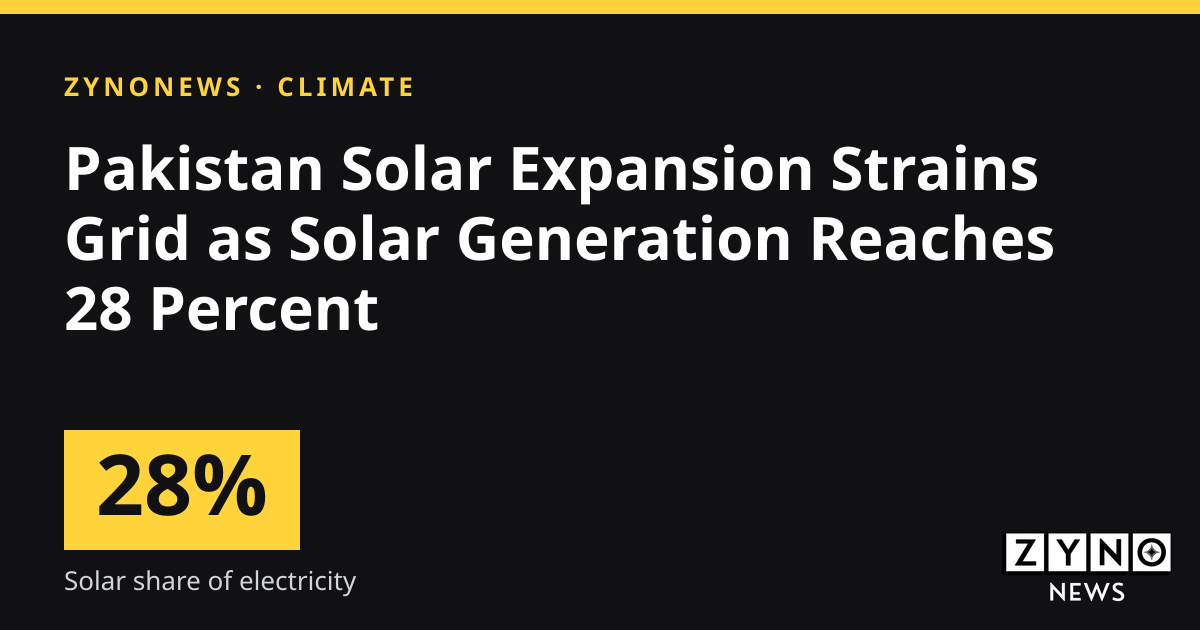
28% Pakistan Solar Expansion Strains Grid as Solar Generation Reaches 28 Percent
Pakistan's solar share grew to 28% • Grid exodus cost over $500 million a year • Officials plan for 90% clean power by 2036.
At a glance
- From 2018 to 2025, Pakistan's share of electricity generated from solar energy rose from 1% to 28%.
- Approximately seven million households in Pakistan now own solar panels.
- The exodus from the national grid has cost the rest of the consumers more than $500 million a year over the past two years.
- Next: The government's plan to run the country on up to 90% clean power by the end of 2036.
Drafted with AI from named sources and checked automatically; published by our AI editor after passing every check. How briefs are made
- BBC Asia
The story
From 2018 to 2025, Pakistan's share of electricity generated from solar energy rose from 1% to 28%. This rapid growth marks a major change in how the country produces power.
The shift has brought heavy costs for traditional infrastructure. Energy Minister Awais Ahmad Leghari stated that the exodus from the grid has cost the rest of the consumers more than $500 million a year over the past two years. Meanwhile, monthly electricity bills for families like Faizal Shahzad's have risen to 15,000-18,000 rupees.
Energy Minister Awais Ahmad Leghari stated that the government wants the country to run on up to 90% clean power by the end of 2036 and called the grid exodus a healthy thing because people found a way to survive. On the other side, Muhammad Hassan Dajana stated that the grid risks becoming a white elephant that requires heavy public funding to stay afloat.
What each side says
Government of Pakistan
“People have just found another way to be able to survive. It's a very healthy thing.”Awais Ahmad Leghari
Analysts
“You'll have a white elephant in the form of a state-owned enterprise that requires a lot of public funding to just stay afloat”Muhammad Hassan Dajana
Should Pakistan continue to encourage the widespread adoption of private solar power?
For yes: People have just found another way to be able to survive.
For no: You'll have a white elephant requiring public funding to stay afloat.
What the research says6 studies, 2019–2024
This literature review examines the historical context and academic research surrounding Pakistan's energy sector, providing a foundational overview prior to recent developments in solar adoption and grid infrastructure. It reviews how historical power challenges, renewable energy integration, and grid stability relate to contemporary trends. The review is organised chronologically by the historical background of Pakistan's power generation, followed by thematic discussions on energy crises and renewable transitions, and concludes with identified gaps in the existing literature.
Historical Background of Pakistan Energy
According to the background materials on energy development, Pakistan established its first commercial nuclear plant in 1972 as part of its early electrical generation history1. Over subsequent decades, the country's power sector continued to incorporate various generation technologies, including photovoltaic systems which convert sunlight into electric current using the photovoltaic effect, and concentrated solar power systems that use lenses or mirrors to drive steam turbines2.
65% of the nation's total electric energy generation through six operating reactors1. As reported in recent data covering the period from 2018 to 2025, the country's share of electricity generated from solar energy experienced substantial growth, rising from 1% to 28%3. Furthermore, background documents note plans for continued nuclear expansion alongside ongoing infrastructure developments to address national energy security1.
Power Crises and Grid Challenges
Academic literature extensively documents the persistent difficulties facing Pakistan's electricity network. Raza et al. (2022)4 stated that the power sector faces departmental mismanagement, heavy dependence on imported fossil fuels, high generation costs, and outdated monitoring devices, which have driven energy crises for two decades. Similarly, Baloch et al. (2019)5 stated that power outages caused by generation shortages, transmission losses, and inappropriate policies have severely affected domestic, industrial, health, and education sectors, while the government has remained unable to resolve the dilemma.
Irfan et al. (2019)6 noted that energy generation relies heavily on fossil fuels that fail to meet existing industrial and population needs, carry adverse environmental impacts, and remain economically unsuitable for electrifying remote areas. हुसैन et al. (2023)7 stated that Pakistan faces water scarcity and high operational costs in traditional irrigation, noting that solar-powered irrigation systems encounter technical, financial, and policy barriers.
Reports further detail the financial impact of changing consumption patterns, noting that consumer shifts away from the national grid have cost remaining consumers more than $500 million a year over a two-year period3, while family electricity bills have risen to 15,000-18,000 rupees3 against an average monthly wage of just under 40,000 rupees3.
Renewable Integration and Grid Stability
Research addressing the technical integration of renewables highlights both potential benefits and structural challenges. Smith et al. (2022)8 stated that the contemporary proliferation of renewable power generation causes an overhaul in electrical grid topology, composition, and dynamics, noting that distributed household-level generators affect network stability and resilience with daily oscillations. To address these integration hurdles, Adeyinka et al.
(2024)9 stated that hybrid energy storage systems combine multiple storage devices to mitigate the intermittent and variable nature of renewable sources such as wind, solar, and hydropower. In the context of national policy and targets, Energy Minister Awais Ahmad Leghari stated that the government aims for the country to run on up to 90% clean power by the end of 20363.
Concurrently, reports indicate that approximately seven million households in Pakistan now own solar panels3, reflecting widespread adoption amidst broader efforts to expand solar power capacity across the electrical grid10.
The current literature does not yet provide comprehensive empirical data on the long-term financial feedback loops between household grid defections and utility insolvency. While sources acknowledge the rapid rise in household solar ownership and national solar generation shares, there is a lack of localized network studies measuring the precise voltage fluctuations caused by seven million decentralized rooftop systems. Furthermore, sources disagree on the most effective economic mechanisms to balance grid maintenance costs without disproportionately burdening non-solar consumers. Detailed quantitative studies examining the exact implementation costs and infrastructure timelines required to achieve the projected clean power targets by 2036 remain sparse.
Advancements in hybrid energy storage systems for enhancing renewable energy-to-grid integration
Adekanmi Miracle Adeyinka et al. · Sustainable Energy ResearchWhat to watch
- The government's plan to run the country on up to 90% clean power by the end of 2036.
The data
Inflation Trends
Pakistan: 4.5% in 2025 (-18.9 pts from 2024).
dashed = IMF forecastIMF World Economic OutlookDownload data (CSV, opens in Excel)
Show the numbers (31)
Country: Pakistan · Indicator: inflation · Source: IMF World Economic Outlook
| Year | Value | Forecast |
|---|---|---|
| 2001 | 4.4 | no |
| 2002 | 3.5 | no |
| 2003 | 3.1 | no |
| 2004 | 4.6 | no |
| 2005 | 9.3 | no |
| 2006 | 7.9 | no |
| 2007 | 7.8 | no |
| 2008 | 12 | no |
| 2009 | 19.6 | no |
| 2010 | 10.1 | no |
| 2011 | 13.7 | no |
| 2012 | 11 | no |
| 2013 | 7.4 | no |
| 2014 | 8.6 | no |
| 2015 | 4.5 | no |
| 2016 | 2.9 | no |
| 2017 | 4.8 | no |
| 2018 | 4.7 | no |
| 2019 | 6.8 | no |
| 2020 | 10.7 | no |
| 2021 | 8.9 | no |
| 2022 | 12.2 | no |
| 2023 | 29.2 | no |
| 2024 | 23.4 | no |
| 2025 | 4.5 | no |
| 2026 | 7.1 | yes |
| 2027 | 9.9 | yes |
| 2028 | 7 | yes |
| 2029 | 6.5 | yes |
| 2030 | 6.5 | yes |
| 2031 | 6.5 | yes |
Government Debt Percentage of GDP
Pakistan: 72.8% in 2025 (+2.5 pts from 2024).
dashed = IMF forecastIMF World Economic OutlookDownload data (CSV, opens in Excel)
Show the numbers (31)
Country: Pakistan · Indicator: government debt (% of GDP) · Source: IMF World Economic Outlook
| Year | Value | Forecast |
|---|---|---|
| 2001 | 65.1 | no |
| 2002 | 60.5 | no |
| 2003 | 56.3 | no |
| 2004 | 50.6 | no |
| 2005 | 47.9 | no |
| 2006 | 46.2 | no |
| 2007 | 44.2 | no |
| 2008 | 49.5 | no |
| 2009 | 54.6 | no |
| 2010 | 56.7 | no |
| 2011 | 56.2 | no |
| 2012 | 58.4 | no |
| 2013 | 59.2 | no |
| 2014 | 58.8 | no |
| 2015 | 59.1 | no |
| 2016 | 62.1 | no |
| 2017 | 62.1 | no |
| 2018 | 66.3 | no |
| 2019 | 78.7 | no |
| 2020 | 80.8 | no |
| 2021 | 74.7 | no |
| 2022 | 77.3 | no |
| 2023 | 78.5 | no |
| 2024 | 70.3 | no |
| 2025 | 72.8 | no |
| 2026 | 69.8 | yes |
| 2027 | 67.7 | yes |
| 2028 | 64.5 | yes |
| 2029 | 61.3 | yes |
| 2030 | 59.6 | yes |
| 2031 | 57.3 | yes |
Real GDP Growth Ranking
Pakistan: 3.2%, 108 of 195 countries (median 3.5%).
IMF World Economic OutlookDownload data (CSV, opens in Excel)
Show the numbers (195)
Indicator: real GDP growth · Year: 2025 · Source: IMF World Economic Outlook
| Rank | Country | Value |
|---|---|---|
| 1 | South Sudan | 41.4 |
| 2 | Guyana | 19.3 |
| 3 | Libya | 15.9 |
| 4 | Kyrgyzstan | 11.1 |
| 5 | Rwanda | 9.4 |
| 6 | Ethiopia | 9.2 |
| 7 | Venezuela | 9 |
| 8 | Taiwan Province of China | 8.8 |
| 9 | Tajikistan | 8.4 |
| 10 | Zimbabwe | 8.3 |
| 11 | Bhutan | 8.2 |
| 12 | Benin | 8.1 |
| 13 | Ireland | 8 |
| 14 | Vietnam | 8 |
| 15 | India | 7.8 |
| 16 | Uzbekistan | 7.7 |
| 17 | Georgia | 7.5 |
| 18 | Armenia | 7.1 |
| 19 | Guinea | 6.9 |
| 20 | Niger | 6.9 |
| 21 | Mongolia | 6.8 |
| 22 | Senegal | 6.7 |
| 23 | Uganda | 6.7 |
| 24 | Paraguay | 6.6 |
| 25 | Côte d'Ivoire | 6.5 |
| 26 | Kazakhstan | 6.5 |
| 27 | Aruba | 6.3 |
| 28 | Cabo Verde | 6.3 |
| 29 | Maldives | 6.3 |
| 30 | Togo | 6.3 |
| 31 | Papua New Guinea | 6.2 |
| 32 | United Arab Emirates | 6.2 |
| 33 | Ghana | 6 |
| 34 | Palau | 6 |
| 35 | Tanzania | 5.9 |
| 36 | Central African Republic | 5.8 |
| 37 | Guinea-Bissau | 5.8 |
| 38 | Seychelles | 5.8 |
| 39 | Democratic Republic of the Congo | 5.7 |
| 40 | The Gambia | 5.7 |
| 41 | Burkina Faso | 5.3 |
| 42 | Cambodia | 5.3 |
| 43 | Malaysia | 5.2 |
| 44 | Tuvalu | 5.2 |
| 45 | Chad | 5.1 |
| 46 | Indonesia | 5.1 |
| 47 | Liberia | 5.1 |
| 48 | China | 5 |
| 49 | Singapore | 5 |
| 50 | Sri Lanka | 5 |
| 51 | Djibouti | 4.9 |
| 52 | Eswatini | 4.9 |
| 53 | Mali | 4.9 |
| 54 | Morocco | 4.9 |
| 55 | Nicaragua | 4.9 |
| 56 | Grenada | 4.8 |
| 57 | Laos | 4.8 |
| 58 | Sierra Leone | 4.8 |
| 59 | Macao SAR | 4.7 |
| 60 | Malta | 4.7 |
… 135 more rows in the CSV
IMF World Economic Outlook (IMF data, reused with citation)
Background
At a glance
 Pakistan
- Capital
- Islamabad
- Population
- 240.5 million
- Leaders
- Asif Ali Zardari · Shehbaz Sharif
- Currency
- Pakistani rupee
Wikidata · IMF, 2026-11-18
Sources and method
References (12)
News reports
Studies
- Muhammad Amir Raza et al. (2022). Challenges and potentials of implementing a smart grid for Pakistan’s electric network Energy Strategy Reviews
- Mazhar Hussain Baloch et al. (2019). Hybrid energy sources status of Pakistan: An optimal technical proposal to solve the power crises issues Energy Strategy Reviews
- Muhammad Faisal Irfan et al. (2019). Solar Energy Development in Pakistan: Barriers and Policy Recommendations Sustainability
- Fiaz Hussain et al. (2023). Solar Irrigation Potential, Key Issues and Challenges in Pakistan Water
- O. Smith et al. (2022). The effect of renewable energy incorporation on power grid stability and resilience Science Advances
- Adekanmi Miracle Adeyinka et al. (2024). Advancements in hybrid energy storage systems for enhancing renewable energy-to-grid integration Sustainable Energy Research
Background
- Nuclear power in Pakistan Wikipedia
- Solar power Wikipedia
- Solar power by country Wikipedia
Reports used for this brief
Data
- IMF World Economic Outlook IMF data, reused with citation
How this brief was made
Automated research by ZynoNews: trending topic detected across news, searches and Wikipedia; facts and statements from the reports listed; numbers computed from open data; checked automatically for numbers, sources, copying and neutrality. Version 1. 1 news reports from 1 outlets, 3 official datasets, 6 research studies and 3 background sources.
Cite this
For papers, reports and theses. ZynoNews articles keep their address; updates are listed with their date.
ZynoNews Desk. (2026, November 18). Pakistan Solar Expansion Strains Grid as Solar Generation Reaches 28 Percent. ZynoNews. https://zynonews.org/news/pakistan-solar-expansion-strains-grid-as-solar-generation-reaches-28-percent-3c4017