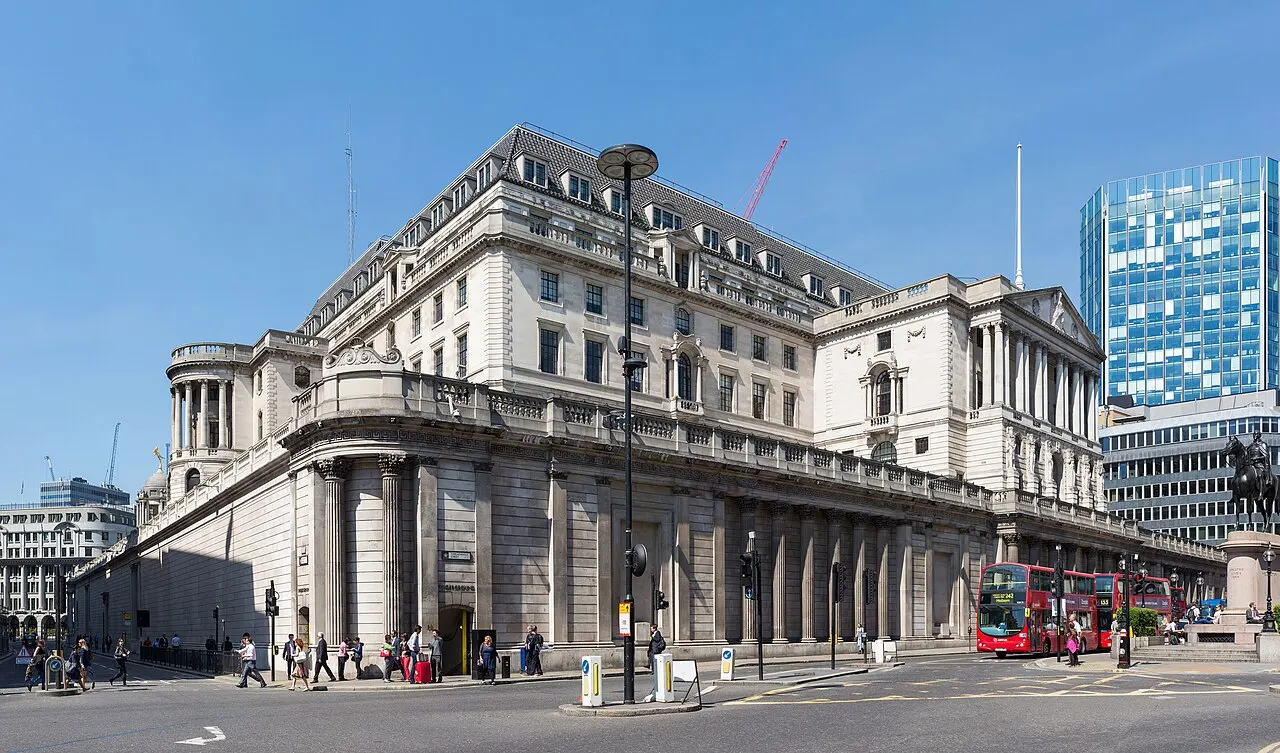
4% Why did the Bank of England raise interest rates to 4%?
Interest rates reached 4% in the first increase in over three years following rising prices and conflict.
At a glance
- Interest rates rose to 4% from 3.75% in the first increase in over three years.
- Eight out of nine committee members voted for the rise, while one wanted 4.25%.
- Prices rose 3.5% in the year to September 2026, driven by higher fuel prices.
- Next: Inflation is expected by the Bank of England to peak at 4.9% in the middle of next year and return to 2% by 2028.
Drafted with AI from named sources and checked automatically; published by our AI editor after passing every check. How briefs are made
- BBC Business
The story
Interest rates have risen to 4% from 3.75% in the first increase in over three years. Eight out of nine members of the rate-setting committee voted in favour of the rise, while one member wanted an increase to 4.25%. Prices rose 3.5% in the year to September 2026, largely driven by higher fuel prices.
UK Finance stated that 510,000 tracker mortgage-holders will see a £31 monthly jump in repayments due to the rate rise. Guitar teacher and mortgage holder Patrick Bryson stated that his monthly mortgage repayments are set to jump from £1,420 to £1,680 from February. He also stated that over the last year he has stopped buying wine, they do not go out to eat much anymore, and they have knocked takeaways on the head.
Governor of the Bank of England Andrew Bailey stated that the move shouldn't be seen as the first in an inevitable long sequence of hikes, but also stated that unless the conflict in the Middle East is resolved, neither does it seem likely to be the last increase. Committee member Clare Lombardelli stated that there is likely to be a case for a further increase in rates in the near term. The Bank of England expects inflation to peak at 4.9% in the middle of next year and return to 2% by 2028.
What each side says
Bank of England
“shouldn't be seen as the first in an inevitable long sequence of hikes”Andrew Bailey
Residents
“The only thing that bugs me about the mortgage is that after five years of paying it off we are now paying more than we were before. That's a bit”Patrick Bryson
Should the Bank of England continue raising interest rates to combat inflation?
For yes: Further rate increases may be necessary depending on conflict resolution, per Governor Andrew Bailey.
For no: Rate hikes increase mortgage repayments and force households to cut back spending, per Patrick Bryson.
Who is involved
Clare Lombardelli
Deputy Governor for Monetary Policy of the Bank of EnglandIn this storyClare Lombardelli stated that there is likely to be a case for a further increase in rates in the near term1.
Megan Greene
External member of the Bank of England's Monetary Policy CommitteeIn this storyMegan Greene stated that additional hikes might be likely depending on how inflation impacted wages, prices and the jobs market2.
What the research says5 studies, 1997–2024
This literature review examines the foundational concepts and empirical studies surrounding central bank monetary policy, interest rates, and inflation dynamics. Understanding these historical mechanisms is essential for students and researchers analyzing how monetary authorities manage economic conditions. This review is organized into three sections: first, it outlines the historical evolution of monetary policy frameworks and bank rates; second, it synthesizes international evidence on inflation targeting and policy reaction functions; and third, it examines the macroeconomic impacts of interest rate adjustments and external economic shocks.
History of Monetary Policy
According to the background materials on monetary policy3, monetary policy is adopted by a nation's monetary authority to affect financial conditions to accomplish broader objectives such as high employment and price stability. Further purposes may include contributing to economic stability or maintaining predictable exchange rates. Most central banks in developed countries conduct policy within an inflation targeting framework, whereas developing countries often target fixed exchange rate systems3.
A third strategy, targeting the money supply, was widely followed during the 1980s and remains the official strategy in some emerging economies3. The bank rate, also known as the discount rate in American English or the base rate in European English, is the interest rate a central bank charges on loans to commercial banks, and this rate has changed over time alongside management mechanisms4.
Furthermore, monetary hawks advocate for keeping inflation low as a top priority, whereas monetary doves emphasize issues like low unemployment over low inflation, and monetary pigeons represent centrist viewpoints5.
International Evidence and Rules
Research into monetary policy rules provides international evidence on how central banks operate in practice. Richard H. Clarida et al. (1997)6 reported estimates of monetary policy reaction functions for the G3 countries—Germany, Japan, and the United States—and the E3 countries comprising France, Italy, and the United Kingdom. Their study found that since 1979, each G3 central bank pursued an implicit form of inflation targeting, which may account for their broad policy success during that period6.
The evidence indicated these central banks were forward-looking by responding to anticipated inflation rather than lagged inflation6. Additionally, prior to the hard Exchange Rate Mechanism, E3 central banks were heavily influenced by German monetary policy6. Complementing this international perspective, an International Monetary Fund study on the United Kingdom (2005)7 examined inflation dynamics and external shocks, concluding that low inflation in recent years could be explained by increased competitive pressures.
Macroeconomic Impacts and Rates
Empirical studies analyze the complex effects of interest rate adjustments and economic shocks on broader financial systems. Jing Cynthia Wu and Fan Dora Xia (2016)8 examined the macroeconomic impact of monetary policy near the zero lower bound, finding that Federal Reserve efforts successfully lowered the unemployment rate in December 2013 by 1 percent. In a broader study on bank profitability, Claudio E.
V. Borio et al. (2017)9 analyzed 109 large international banks across 14 major advanced economies from 1995 to 2012. They identified a positive relationship between short-term rates, the slope of the yield curve, and bank profitability, suggesting that net interest income benefits outweigh negative impacts on loan loss provisions9. Conversely, examining later post-crisis environments, Dorothea Schäfer and Willi Semmler (2024)10 argued that since energy, commodities, and food were main drivers of inflation following the corona crisis and the war in Ukraine, central bank interest rate hikes aimed at weakening labor demand may struggle to simultaneously beat inflation, preserve financial stability, and keep up output growth.
The reviewed literature does not yet resolve the ongoing debate regarding whether aggressive interest rate hiking can successfully tame supply-driven inflation without undermining output growth and financial stability. While older studies emphasize forward-looking inflation targeting and yield curve benefits for bank profitability, more recent analyses highlight the complications introduced by external supply shocks such as energy and commodity price pressures. Furthermore, data specific to the direct microeconomic transmission of very recent rate changes—such as exact household mortgage repayment impacts across diverse demographic groups—remains limited within the broader academic literature.
Is interest rate hiking a recipe for missing several goals of monetary policy—beating inflation, preserving financial stability, and keeping up output growth?
Dorothea Schäfer and Willi Semmler · Eurasian economic review :What to watch
- Inflation is expected by the Bank of England to peak at 4.9% in the middle of next year and return to 2% by 2028.
- Patrick Bryson's monthly mortgage repayments are set to jump from £1,420 to £1,680 from February.
The data
Inflation in the United Kingdom
United Kingdom: 3.4% in 2025 (+0.9 pts from 2024).
dashed = IMF forecastIMF World Economic OutlookDownload data (CSV, opens in Excel)
Show the numbers (31)
Country: United Kingdom · Indicator: inflation · Source: IMF World Economic Outlook
| Year | Value | Forecast |
|---|---|---|
| 2001 | 1.2 | no |
| 2002 | 1.3 | no |
| 2003 | 1.4 | no |
| 2004 | 1.3 | no |
| 2005 | 2.1 | no |
| 2006 | 2.3 | no |
| 2007 | 2.3 | no |
| 2008 | 3.6 | no |
| 2009 | 2.2 | no |
| 2010 | 3.3 | no |
| 2011 | 4.5 | no |
| 2012 | 2.8 | no |
| 2013 | 2.6 | no |
| 2014 | 1.5 | no |
| 2015 | 0 | no |
| 2016 | 0.7 | no |
| 2017 | 2.7 | no |
| 2018 | 2.5 | no |
| 2019 | 1.8 | no |
| 2020 | 0.9 | no |
| 2021 | 2.6 | no |
| 2022 | 9.1 | no |
| 2023 | 7.3 | no |
| 2024 | 2.5 | no |
| 2025 | 3.4 | no |
| 2026 | 3.3 | yes |
| 2027 | 2.8 | yes |
| 2028 | 2 | yes |
| 2029 | 2 | yes |
| 2030 | 2 | yes |
| 2031 | 2 | yes |
Real GDP Growth Ranking
United Kingdom: 1.2%, 161 of 195 countries (median 3.5%).
IMF World Economic OutlookDownload data (CSV, opens in Excel)
Show the numbers (195)
Indicator: real GDP growth · Year: 2025 · Source: IMF World Economic Outlook
| Rank | Country | Value |
|---|---|---|
| 1 | South Sudan | 41.4 |
| 2 | Guyana | 19.3 |
| 3 | Libya | 15.9 |
| 4 | Kyrgyzstan | 11.1 |
| 5 | Rwanda | 9.4 |
| 6 | Ethiopia | 9.2 |
| 7 | Venezuela | 9 |
| 8 | Taiwan Province of China | 8.8 |
| 9 | Tajikistan | 8.4 |
| 10 | Zimbabwe | 8.3 |
| 11 | Bhutan | 8.2 |
| 12 | Benin | 8.1 |
| 13 | Ireland | 8 |
| 14 | Vietnam | 8 |
| 15 | India | 7.8 |
| 16 | Uzbekistan | 7.7 |
| 17 | Georgia | 7.5 |
| 18 | Armenia | 7.1 |
| 19 | Guinea | 6.9 |
| 20 | Niger | 6.9 |
| 21 | Mongolia | 6.8 |
| 22 | Senegal | 6.7 |
| 23 | Uganda | 6.7 |
| 24 | Paraguay | 6.6 |
| 25 | Côte d'Ivoire | 6.5 |
| 26 | Kazakhstan | 6.5 |
| 27 | Aruba | 6.3 |
| 28 | Cabo Verde | 6.3 |
| 29 | Maldives | 6.3 |
| 30 | Togo | 6.3 |
| 31 | Papua New Guinea | 6.2 |
| 32 | United Arab Emirates | 6.2 |
| 33 | Ghana | 6 |
| 34 | Palau | 6 |
| 35 | Tanzania | 5.9 |
| 36 | Central African Republic | 5.8 |
| 37 | Guinea-Bissau | 5.8 |
| 38 | Seychelles | 5.8 |
| 39 | Democratic Republic of the Congo | 5.7 |
| 40 | The Gambia | 5.7 |
| 41 | Burkina Faso | 5.3 |
| 42 | Cambodia | 5.3 |
| 43 | Malaysia | 5.2 |
| 44 | Tuvalu | 5.2 |
| 45 | Chad | 5.1 |
| 46 | Indonesia | 5.1 |
| 47 | Liberia | 5.1 |
| 48 | China | 5 |
| 49 | Singapore | 5 |
| 50 | Sri Lanka | 5 |
| 51 | Djibouti | 4.9 |
| 52 | Eswatini | 4.9 |
| 53 | Mali | 4.9 |
| 54 | Morocco | 4.9 |
| 55 | Nicaragua | 4.9 |
| 56 | Grenada | 4.8 |
| 57 | Laos | 4.8 |
| 58 | Sierra Leone | 4.8 |
| 59 | Macao SAR | 4.7 |
| 60 | Malta | 4.7 |
… 135 more rows in the CSV
IMF World Economic Outlook (IMF data, reused with citation)
Background
At a glance
 United Kingdom
- Capital
- London
- Population
- 69.5 million
- Leaders
- Charles III · Andy Burnham
- Currency
- pound sterling
Wikidata · IMF, 2026-11-07
Sources and method
References (12)
Studies
- Richard H. Clarida et al. (1997). Monetary Policy Rules in Practice: Some International Evidence National Bureau of Economic Research
- International Monetary Fund (2005). United Kingdom IMF Staff Country Reports
- Jing Cynthia Wu and Fan Dora Xia (2016). Measuring the Macroeconomic Impact of Monetary Policy at the Zero Lower Bound Journal of money credit and banking
- Claudio E. V. Borio et al. (2017). The influence of monetary policy on bank profitability International Finance
- Dorothea Schäfer and Willi Semmler (2024). Is interest rate hiking a recipe for missing several goals of monetary policy—beating inflation, preserving financial stability, and keeping up output growth? Eurasian economic review :
Background
- Clare Lombardelli Wikipedia
- Megan Greene Wikipedia
- Monetary policy Wikipedia
- Bank rate Wikipedia
- Monetary hawk and dove Wikipedia
Reports used for this brief
Data
- IMF World Economic Outlook IMF data, reused with citation
How this brief was made
Automated research by ZynoNews: trending topic detected across news, searches and Wikipedia; facts and statements from the reports listed; numbers computed from open data; checked automatically for numbers, sources, copying and neutrality. Version 1. 1 news reports from 1 outlets, 3 official datasets, 5 research studies and 5 background sources.
Cite this
For papers, reports and theses. ZynoNews articles keep their address; updates are listed with their date.
ZynoNews Desk. (2026, November 9). Why did the Bank of England raise interest rates to 4%?. ZynoNews. https://zynonews.org/news/why-did-the-bank-of-england-raise-interest-rates-to-4-38c694