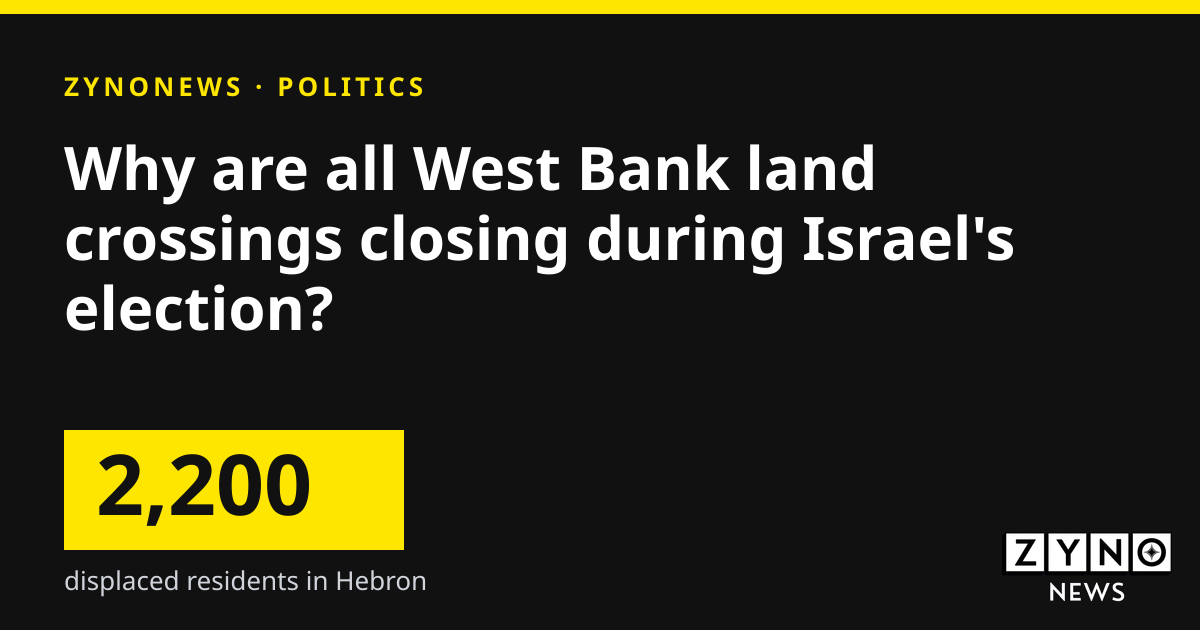
2,200 Why are all West Bank land crossings closing during Israel's election?
Israel closes all West Bank land crossings for the parliamentary election as security crackdowns and military operations escalate.
At a glance
- All West Bank land crossings will be closed during Israel's election, and Palestinian workers are barred from entering settlements.
- Two Israeli soldiers and two Palestinian gunmen were killed in a checkpoint attack, and three other soldiers were injured.
- Thousands gathered in Tel Aviv for an anti-government demonstration organized by the October Council.
- The Israeli military cordoned off Hebron, displacing approximately 2,200 people from their homes.
- Next: Israel's parliamentary election scheduled for Tuesday, October 27.
Drafted with AI from named sources and checked automatically; published by our AI editor after passing every check. How briefs are made
- BBC World
- DW
- BBC Middle East
The story
All West Bank land crossings will be closed during Tuesday's parliamentary election in Israel. Palestinian workers are barred from entering all settlements and industrial zones during these restrictions.
The security measures affect thousands of people across the region. Approximately 2,200 residents have been forced from their homes in Hebron, where the military cordoned off the city and heavily restricted movement for its 200,000 residents. Meanwhile, Israel's unemployment rate stood at 3% in 2025, and real GDP growth reached 3.5%.
The Government of Israel stated through the Israel Defense Forces that the ban covers the entry and exit of Palestinian workers throughout Judea and Samaria and the Jordan Valley. Finance Minister Bezalel Smotrich warned that anyone who messes with Israel will pay a painful price. On the other side, Hebron Mayor Youssef al-Jaabari said the military actions were driven by the elections. The parliamentary election is scheduled for Tuesday, October 27.
What each side says
Government of Israel
“ban on the entry and exit of Palestinian workers throughout Judea and Samaria and the Jordan Valley, including industrial zones, as well as the closure of all land crossings”Israel Defense Forces
Local Officials and Residents
“driven by the elections”Youssef al-Jaabari
Who is involved
Israel Defense Forces
National military of the State of IsraelIn this storyThe Israel Defense Forces implemented a ban on the entry and exit of Palestinian workers throughout Judea, Samaria, and the Jordan Valley, including industrial zones, alongside the closure of all land crossings2.
Benjamin Netanyahu
Prime Minister of IsraelIn this storyBenjamin Netanyahu described an event as a very big surprise3,2.
Israel Katz
Minister of Defense of IsraelIn this storyIsrael Katz stated that about 2,000 residents had been displaced by the operation4,5.
How we got here
- 2026-10-27Israel's parliamentary election is scheduled.
What the research says4 studies, 1996–2019
This literature review examines the established research concerning border closures, infrastructure control, and civil-military relations in Israel and the West Bank, providing context for the parliamentary election and associated security measures2,5. Previous academic literature and reports explore how mobility restrictions affect labor and civilian life, the administrative logic of control, and the intersection of military and political elites7,8,9.
This review is organized chronologically to trace the historical relationship between security measures and governance, followed by thematic discussions on labor impacts, infrastructure, and institutional dynamics.
Civil-Military Dynamics and Infrastructure
Early research by Etzioni-Halevy (1996)8 documented the close connection between the military elite and the government elite in Israel, arguing that this relationship lends the government an unfair electoral advantage over the opposition through shared policies, political appointments, and career transitions. Building on the context of long-term occupation, Weinthal and Sowers (2019)10 analyzed how state and non-state actors have systematically targeted civilian infrastructure across the West Bank and Gaza over more than five decades.
Utilizing original databases and interviews with humanitarian and government officials, Weinthal and Sowers10 examined how disruptions to water, energy, and agricultural infrastructure created humanitarian crises and undermined civilian livelihoods. These foundational studies establish that administrative and military mechanisms have long intersected with political structures and civilian infrastructure in the region.
Mobility Restrictions and Labor Flows
Subsequent research turned to the specific impacts of border closures and physical obstacles on the daily lives of residents. Adnan (2015)9 examined how labor mobility restrictions, such as border closures and work permits, affect West Bank labor flows. Adnan9 found that mobility restrictions significantly reduce out-migration to Israel proper compared to Israeli settlements, and that an increased frequency of border closures raises the risk of unemployment, particularly for migrant workers residing outside Jerusalem.
Complementing these economic findings, Joronen (2017)7 investigated the operational logic of Israeli state apparatuses in governing the Palestinian population through slowness, delay, and waiting. Joronen7 focused on sites near expanding Israeli settlements to demonstrate how precarity is maintained by recognizing rights without actualizing them. Together, these studies show that mobility barriers operate through both physical economic restrictions and administrative delays.
The reviewed literature does not yet show how temporary crossing closures implemented specifically during modern election periods quantitatively alter voting behavior or alter the long-term economic trajectories identified in earlier labor studies [9]. While sources extensively document the general economic costs of mobility restrictions and the structural ties between military and political elites [8, 9], there is a lack of real-time data connecting acute security crackdowns, such as recent checkpoint attacks and military cordons [2], with the immediate administrative decisions surrounding electoral closures [2]. Furthermore, sources diverge on the exact weight assigned to security versus political motivations when implementing sweeping regional restrictions.
Targeting infrastructure and livelihoods in the West Bank and Gaza
Erika S. Weinthal and Jeannie Sowers · International AffairsWhat to watch
- Israel's parliamentary election scheduled for Tuesday, October 27.
- The closure of all West Bank land crossings during Tuesday's election.
The data
Real GDP Growth Ranking, Israel
Israel: 3.5%, 102 of 195 countries (median 3.5%).
IMF World Economic OutlookDownload data (CSV, opens in Excel)
Show the numbers (195)
Indicator: real GDP growth · Year: 2025 · Source: IMF World Economic Outlook
| Rank | Country | Value |
|---|---|---|
| 1 | South Sudan | 41.4 |
| 2 | Guyana | 19.3 |
| 3 | Libya | 15.9 |
| 4 | Kyrgyzstan | 11.1 |
| 5 | Rwanda | 9.4 |
| 6 | Ethiopia | 9.2 |
| 7 | Venezuela | 9 |
| 8 | Taiwan Province of China | 8.8 |
| 9 | Tajikistan | 8.4 |
| 10 | Zimbabwe | 8.3 |
| 11 | Bhutan | 8.2 |
| 12 | Benin | 8.1 |
| 13 | Ireland | 8 |
| 14 | Vietnam | 8 |
| 15 | India | 7.8 |
| 16 | Uzbekistan | 7.7 |
| 17 | Georgia | 7.5 |
| 18 | Armenia | 7.1 |
| 19 | Guinea | 6.9 |
| 20 | Niger | 6.9 |
| 21 | Mongolia | 6.8 |
| 22 | Senegal | 6.7 |
| 23 | Uganda | 6.7 |
| 24 | Paraguay | 6.6 |
| 25 | Côte d'Ivoire | 6.5 |
| 26 | Kazakhstan | 6.5 |
| 27 | Aruba | 6.3 |
| 28 | Cabo Verde | 6.3 |
| 29 | Maldives | 6.3 |
| 30 | Togo | 6.3 |
| 31 | Papua New Guinea | 6.2 |
| 32 | United Arab Emirates | 6.2 |
| 33 | Ghana | 6 |
| 34 | Palau | 6 |
| 35 | Tanzania | 5.9 |
| 36 | Central African Republic | 5.8 |
| 37 | Guinea-Bissau | 5.8 |
| 38 | Seychelles | 5.8 |
| 39 | Democratic Republic of the Congo | 5.7 |
| 40 | The Gambia | 5.7 |
| 41 | Burkina Faso | 5.3 |
| 42 | Cambodia | 5.3 |
| 43 | Malaysia | 5.2 |
| 44 | Tuvalu | 5.2 |
| 45 | Chad | 5.1 |
| 46 | Indonesia | 5.1 |
| 47 | Liberia | 5.1 |
| 48 | China | 5 |
| 49 | Singapore | 5 |
| 50 | Sri Lanka | 5 |
| 51 | Djibouti | 4.9 |
| 52 | Eswatini | 4.9 |
| 53 | Mali | 4.9 |
| 54 | Morocco | 4.9 |
| 55 | Nicaragua | 4.9 |
| 56 | Grenada | 4.8 |
| 57 | Laos | 4.8 |
| 58 | Sierra Leone | 4.8 |
| 59 | Macao SAR | 4.7 |
| 60 | Malta | 4.7 |
… 135 more rows in the CSV
Inflation Ranking, Israel
Israel: 3%, 96 of 195 countries (median 3%).
IMF World Economic OutlookDownload data (CSV, opens in Excel)
Show the numbers (195)
Indicator: inflation · Year: 2025 · Source: IMF World Economic Outlook
| Rank | Country | Value |
|---|---|---|
| 1 | Venezuela | 252 |
| 2 | Sudan | 99.9 |
| 3 | South Sudan | 97.6 |
| 4 | Zimbabwe | 81.4 |
| 5 | Iran | 50.6 |
| 6 | Argentina | 41.9 |
| 7 | Türkiye | 34.9 |
| 8 | Burundi | 34 |
| 9 | Malawi | 28.4 |
| 10 | Haiti | 28.3 |
| 11 | Nigeria | 23 |
| 12 | Myanmar | 21.1 |
| 13 | Egypt | 20.4 |
| 14 | Angola | 20.2 |
| 15 | Yemen | 20.2 |
| 16 | Bolivia | 19.5 |
| 17 | Ethiopia | 16 |
| 18 | Lebanon | 14.6 |
| 19 | Ghana | 14.2 |
| 20 | Zambia | 13.9 |
| 21 | Ukraine | 12.7 |
| 22 | Kazakhstan | 11.4 |
| 23 | West Bank and Gaza | 10.5 |
| 24 | Bangladesh | 10 |
| 25 | Suriname | 9.2 |
| 26 | Uzbekistan | 8.8 |
| 27 | Russia | 8.7 |
| 28 | Mongolia | 8.6 |
| 29 | Liberia | 8.3 |
| 30 | Kyrgyzstan | 8.2 |
| 31 | Madagascar | 8 |
| 32 | The Gambia | 7.9 |
| 33 | Moldova | 7.8 |
| 34 | Laos | 7.7 |
| 35 | Sierra Leone | 7.6 |
| 36 | Democratic Republic of the Congo | 7.4 |
| 37 | Romania | 7.3 |
| 38 | Rwanda | 7 |
| 39 | Belarus | 6.6 |
| 40 | Naoero | 6.1 |
| 41 | Kiribati | 5.9 |
| 42 | Azerbaijan | 5.6 |
| 43 | Tunisia | 5.3 |
| 44 | Colombia | 5.1 |
| 45 | Brazil | 5 |
| 46 | Estonia | 4.8 |
| 47 | Uruguay | 4.7 |
| 48 | Honduras | 4.6 |
| 49 | Pakistan | 4.5 |
| 50 | Croatia | 4.4 |
| 51 | Hungary | 4.4 |
| 52 | Mozambique | 4.4 |
| 53 | Papua New Guinea | 4.4 |
| 54 | Chile | 4.2 |
| 55 | Slovakia | 4.2 |
| 56 | Iceland | 4.1 |
| 57 | Kenya | 4.1 |
| 58 | Marshall Islands | 4.1 |
| 59 | Nepal | 4.1 |
| 60 | North Macedonia | 4.1 |
… 135 more rows in the CSV
Unemployment Rate, Israel
Israel: 3% in 2025 (+0 pts from 2024).
dashed = IMF forecastIMF World Economic OutlookDownload data (CSV, opens in Excel)
Show the numbers (31)
Country: Israel · Indicator: unemployment rate · Source: IMF World Economic Outlook
| Year | Value | Forecast |
|---|---|---|
| 2001 | 11.6 | no |
| 2002 | 12.9 | no |
| 2003 | 13.4 | no |
| 2004 | 12.9 | no |
| 2005 | 11.2 | no |
| 2006 | 10.5 | no |
| 2007 | 9.2 | no |
| 2008 | 7.7 | no |
| 2009 | 9.4 | no |
| 2010 | 8.3 | no |
| 2011 | 7.1 | no |
| 2012 | 6.9 | no |
| 2013 | 6.2 | no |
| 2014 | 5.9 | no |
| 2015 | 5.2 | no |
| 2016 | 4.8 | no |
| 2017 | 4.2 | no |
| 2018 | 4 | no |
| 2019 | 3.8 | no |
| 2020 | 4.3 | no |
| 2021 | 5 | no |
| 2022 | 3.8 | no |
| 2023 | 3.4 | no |
| 2024 | 3 | no |
| 2025 | 3 | no |
| 2026 | 3.1 | yes |
| 2027 | 3.2 | yes |
| 2028 | 3.3 | yes |
| 2029 | 3.5 | yes |
| 2030 | 3.6 | yes |
| 2031 | 3.6 | yes |
IMF World Economic Outlook (IMF data, reused with citation)
Background
At a glance
 Israel
- Capital
- Jerusalem
- Population
- 10.1 million
- Leaders
- Isaac Herzog · Benjamin Netanyahu
- Currency
- new shekel
Wikidata · IMF, 2026-10-26
Sources and method
References (14)
News reports
- Israel to close West Bank crossings on election day as crackdown escalates BBC World
- Israel to close all West Bank land crossings on election day DW
Studies
- Mikko Joronen (2017). Spaces of waiting: Politics of precarious recognition in the occupied West Bank Environment and Planning D Society and Space
- Eva Etzioni‐Halevy (1996). Civil-Military Relations and Democracy: The Case of the Military-Political Elites' Connection in Israel Armed Forces & Society
- Wifag Adnan (2015). Who gets to cross the border? The impact of mobility restrictions on labor flows in the West Bank Labour Economics
- Erika S. Weinthal and Jeannie Sowers (2019). Targeting infrastructure and livelihoods in the West Bank and Gaza International Affairs
Background
- Israel Defense Forces Wikipedia
- Benjamin Netanyahu Wikipedia
- Israel Katz Wikipedia
- Bezalel Smotrich Wikipedia
Reports used for this brief
- Israel to close West Bank crossings on election day as crackdown escalates BBC World
- Israel to close all West Bank land crossings on election day DW
- Israel to close West Bank crossings on election day as crackdown escalates BBC Middle East
Data
- IMF World Economic Outlook IMF data, reused with citation
How this brief was made
Automated research by ZynoNews: trending topic detected across news, searches and Wikipedia; facts and statements from the reports listed; numbers computed from open data; checked automatically for numbers, sources, copying and neutrality. Version 1. 3 news reports from 3 outlets, 3 official datasets, 4 research studies and 4 background sources.
Cite this
For papers, reports and theses. ZynoNews articles keep their address; updates are listed with their date.
ZynoNews Desk. (2026, October 27). Why are all West Bank land crossings closing during Israel's election?. ZynoNews. https://zynonews.org/news/why-are-all-west-bank-land-crossings-closing-during-israel-s-election-dcc62a