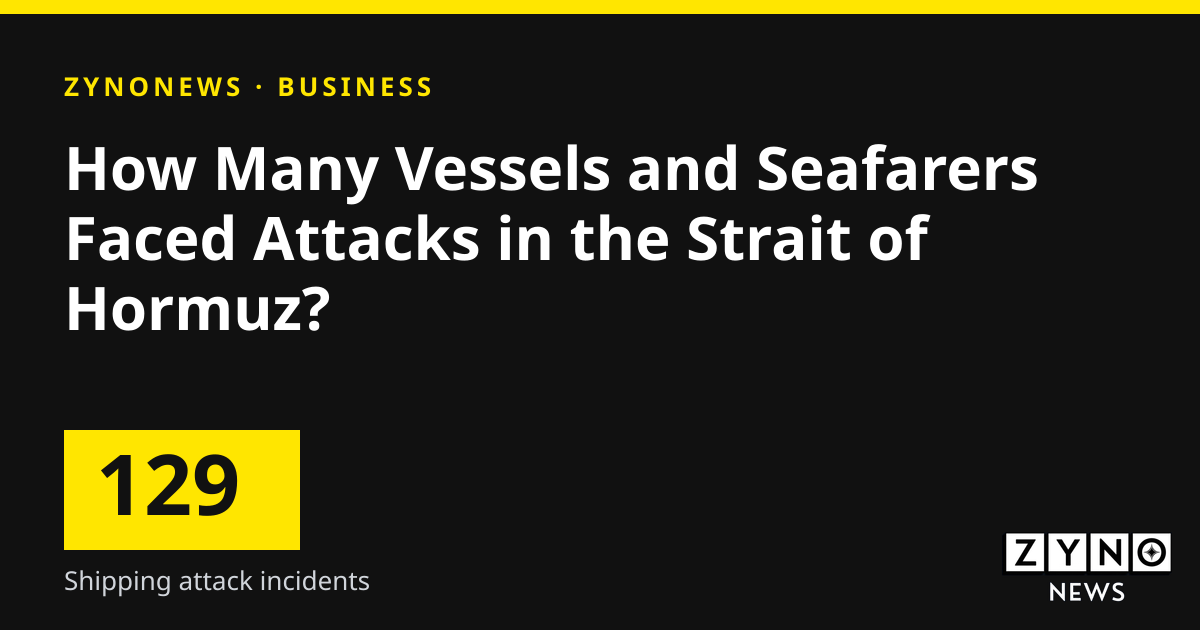
129 How Many Vessels and Seafarers Faced Attacks in the Strait of Hormuz?
At least 129 shipping incidents occurred • 25 seafarers died and 6,000 remain stranded • Shipping industry urges risk assessments amid regional conflict.
At a glance
- Commercial vessels moving through the Strait of Hormuz experienced repeated attacks following military actions involving the US, Israel, and Iran.
- The International Maritime Organization recorded at least 129 shipping attack incidents and 25 seafarer deaths.
- Iran's Islamic Revolutionary Guard Corps stated that three rogue oil tankers traveling an unauthorised route experienced explosions and severe fires.
Drafted with AI from named sources and checked automatically; published by our AI editor after passing every check. How briefs are made
- Al Jazeera
- BBC Middle East
The story
At least 129 incidents involving attacks on shipping were recorded during commercial operations near the Strait of Hormuz and surrounding waters. The International Maritime Organization recorded the deaths of at least 25 seafarers after the US and Israel launched their military actions against Iran.
About 6,000 seafarers remained stranded near the Strait of Hormuz in October, alongside at least 31 vessels hit during commercial shipping operations that month. Among the casualties, at least 16 Indian nationals were killed, while Iran's Islamic Revolutionary Guard Corps stated that three rogue oil tankers traveling an unauthorised route experienced explosions and severe fires.
An International Chamber of Shipping spokesperson stated that placing seafarers in harm's way is unacceptable and that shipowners are working hard to ensure impacted personnel have access to mental health support services and increased calls with family and friends. The spokesperson also stated that shipowners strongly urge all ships operating in the region to conduct thorough risk assessments and to maintain vigilance.
What each side says
Shipping Industry
“It is unacceptable that throughout this conflict seafarers have been placed in harm’s way”Unidentified spokesperson
What the research says6 studies, 2014–2026
This literature review examines the background and prior research surrounding maritime security, geopolitical conflicts, and the welfare of seafarers. Understanding these themes is essential for contextualizing current shipping risks beyond daily news reports. The review is organized into three thematic sections, beginning with historical and regulatory foundations of maritime security, followed by prior analyses of extreme events affecting seafarers, and concluding with research on supply chain disruptions and economic impacts during geopolitical crises.
Historical and Regulatory Foundations
Prior historical context and regulatory frameworks establish baseline standards for maritime safety and security. According to the timeline of the 2026 Iran war, events in the current conflict cover the period since 28 February 20261. To address security challenges in international trade, the International Ship and Port Facility Security Code came into force in 2004 as an amendment to the Safety of Life at Sea Convention (1974/1988)2.
Christian Bueger (2014)3 observed that maritime security has become a prominent term in international relations, noting that while major actors include it in their mandates, no international consensus over the definition of maritime security has emerged. In a broader examination of maritime domains, port security involves defense, law enforcement, counterterrorism activities, and cargo inspection, with risks focusing on physical security or the maritime supply chain4.
Furthermore, historical territorial disputes such as the Kashmir conflict, which began after the partition of India in 1947, demonstrate how long-standing geopolitical tensions can escalate into multiple wars and armed skirmishes among nations like India, Pakistan, and China5.
Impact on Seafarers in Conflict Zones
Research examining the human cost of geopolitical tensions highlights the severe risks faced by maritime personnel operating in dangerous environments. Anish Arvind Hebbar and Teona Khabeishvili (2024)6 investigated the impact on seafarers of extreme events using a case study arising out of the situation in Ukraine, conducting interviews and surveys with seafarers and stakeholders between February 2022 and September 2023.
Their study noted that maritime transportation is the lifeblood of the world's economy, yet seafarers are exposed to isolated, confined, and extreme environments where geopolitical conflicts profoundly impact their mental health, well-being, and safety6. Similarly, Junghwan Choi et al. (2024)7 analyzed sustainable seafarers' employment and welfare systems in South Korea and China, observing that after the coronavirus disease 2019 pandemic, seafarers have become increasingly resistant to acquiring maritime education and performing onboard duties, even though South Korea recognizes them as key agents of national economic growth7.
Supply Chain Resilience and Regional Governance
Broader studies evaluate how geopolitical disruptions affect global supply chains and necessitate regional maritime cooperation. Seung-Jun Lee et al. (2026)8 analyzed the effective closure of the Strait of Hormuz on 28 February 2026, which disrupted approximately 20 million barrels per day of crude oil transit and constituted the largest supply shock in global oil market history.
Their study quantified economic losses and evaluated the Northern Sea Route as a partial mitigation mechanism through frameworks integrating sustainable supply chain resilience, the Triple Bottom Line, and United Nations Sustainable Development Goals8. To address vulnerabilities in ocean transit, Angel Damayanti (2019)9 discussed the rationale of Indo-Pacific Maritime Cooperation, arguing that collective management of interests at sea is vital for international stability, sea-based trading systems, and sustainable ocean use9.
In addition, Avidit Raj Acharya et al. (2020)10 developed a theoretical model to examine how institutions emerge to limit predation on economic activities in areas without strong states, using northern Somalia as a case study to explain how conflicts between groups can be resolved when economic interests favor productive sectors10.
The existing literature does not yet provide comprehensive empirical data on the long-term psychological and economic outcomes for seafarers stranded specifically in the Strait of Hormuz during the 2026 conflict, as most prior empirical work centers on the Ukraine conflict or general post-pandemic welfare systems. Furthermore, sources differ in their methodological approaches, ranging from qualitative stakeholder interviews and comparative case studies to quantitative supply chain resilience modeling and theoretical game-theoretic frameworks. Data regarding the specific operational status of localized informal security arrangements in the Persian Gulf region remains largely missing from current academic assessments.
How Sustainable Is Arctic Route Diversification? Economic Losses, SDG Trade-Offs, and Supply Chain Resilience in the 2026 Hormuz Crisis
Seung-Jun Lee et al. · SustainabilityThe data
Yemen Real GDP Growth Ranking
Yemen: -0.5%, 188 of 195 countries (median 3.5%).
IMF World Economic OutlookDownload data (CSV, opens in Excel)
Show the numbers (195)
Indicator: real GDP growth · Year: 2025 · Source: IMF World Economic Outlook
| Rank | Country | Value |
|---|---|---|
| 1 | South Sudan | 41.4 |
| 2 | Guyana | 19.3 |
| 3 | Libya | 15.9 |
| 4 | Kyrgyzstan | 11.1 |
| 5 | Rwanda | 9.4 |
| 6 | Ethiopia | 9.2 |
| 7 | Venezuela | 9 |
| 8 | Taiwan Province of China | 8.8 |
| 9 | Tajikistan | 8.4 |
| 10 | Zimbabwe | 8.3 |
| 11 | Bhutan | 8.2 |
| 12 | Benin | 8.1 |
| 13 | Ireland | 8 |
| 14 | Vietnam | 8 |
| 15 | India | 7.8 |
| 16 | Uzbekistan | 7.7 |
| 17 | Georgia | 7.5 |
| 18 | Armenia | 7.1 |
| 19 | Guinea | 6.9 |
| 20 | Niger | 6.9 |
| 21 | Mongolia | 6.8 |
| 22 | Senegal | 6.7 |
| 23 | Uganda | 6.7 |
| 24 | Paraguay | 6.6 |
| 25 | Côte d'Ivoire | 6.5 |
| 26 | Kazakhstan | 6.5 |
| 27 | Aruba | 6.3 |
| 28 | Cabo Verde | 6.3 |
| 29 | Maldives | 6.3 |
| 30 | Togo | 6.3 |
| 31 | Papua New Guinea | 6.2 |
| 32 | United Arab Emirates | 6.2 |
| 33 | Ghana | 6 |
| 34 | Palau | 6 |
| 35 | Tanzania | 5.9 |
| 36 | Central African Republic | 5.8 |
| 37 | Guinea-Bissau | 5.8 |
| 38 | Seychelles | 5.8 |
| 39 | Democratic Republic of the Congo | 5.7 |
| 40 | The Gambia | 5.7 |
| 41 | Burkina Faso | 5.3 |
| 42 | Cambodia | 5.3 |
| 43 | Malaysia | 5.2 |
| 44 | Tuvalu | 5.2 |
| 45 | Chad | 5.1 |
| 46 | Indonesia | 5.1 |
| 47 | Liberia | 5.1 |
| 48 | China | 5 |
| 49 | Singapore | 5 |
| 50 | Sri Lanka | 5 |
| 51 | Djibouti | 4.9 |
| 52 | Eswatini | 4.9 |
| 53 | Mali | 4.9 |
| 54 | Morocco | 4.9 |
| 55 | Nicaragua | 4.9 |
| 56 | Grenada | 4.8 |
| 57 | Laos | 4.8 |
| 58 | Sierra Leone | 4.8 |
| 59 | Macao SAR | 4.7 |
| 60 | Malta | 4.7 |
… 135 more rows in the CSV
Ukraine Exports (% of GDP)
Ukraine: 25.3% in 2025 (-4.34 pts from 2024).
World Bank, World Development IndicatorsDownload data (CSV, opens in Excel)
Show the numbers (25)
Country: Ukraine · Indicator: exports (% of GDP) · Forecast: no · Source: World Bank, World Development Indicators
| Year | Value |
|---|---|
| 2001 | 50.6489878063218 |
| 2002 | 50.1187333965439 |
| 2003 | 52.5431306448415 |
| 2004 | 58.6968317186137 |
| 2005 | 47.7297326846335 |
| 2006 | 43.2186231235111 |
| 2007 | 41.2899111443658 |
| 2008 | 43.2598688559666 |
| 2009 | 42.9288246983766 |
| 2010 | 46.4565383259637 |
| 2011 | 49.4061569340739 |
| 2012 | 47.38283156146 |
| 2013 | 42.8973826672717 |
| 2014 | 48.5929618158503 |
| 2015 | 52.5976795082231 |
| 2016 | 49.2986194577187 |
| 2017 | 48.1249163515559 |
| 2018 | 45.2352356625927 |
| 2019 | 41.2316912560049 |
| 2020 | 38.8216462901934 |
| 2021 | 40.6883404768688 |
| 2022 | 35.4451153382041 |
| 2023 | 28.300468273727 |
| 2024 | 29.6719973021423 |
| 2025 | 25.3335332319508 |
IMF World Economic Outlook (IMF data, reused with citation) · World Bank, World Development Indicators (CC BY 4.0)
Background
At a glance
 Yemen
- Capital
- Aden, Sanaa
- Population
- 18.8 million
- Leaders
- Rashad al-Alimi · Salem Saleh bin Braik
- Currency
- Yemeni rial
 Ukraine
- Capital
- Kyiv
- Population
- 32.9 million
- Leaders
- Volodymyr Zelenskyy · Serhii Koretskyi
- Currency
- hryvnia
 Russia
- Capital
- Moscow
- Population
- 144 million
- Leaders
- Vladimir Putin · Mikhail Mishustin
- Currency
- Russian ruble
Wikidata · IMF, 2026-11-09
Sources and method
References (14)
Studies
- Christian Bueger (2014). What is maritime security? Marine Policy
- Anish Arvind Hebbar and Teona Khabeishvili (2024). Impact on seafarers of extreme events: A case study arising out of the situation in Ukraine International Maritime Health
- Junghwan Choi et al. (2024). Comparative Analysis of Sustainable Seafarers’ Employment and Welfare Systems in South Korea and China: Contemporary Issues and Improvements Sustainability
- Seung-Jun Lee et al. (2026). How Sustainable Is Arctic Route Diversification? Economic Losses, SDG Trade-Offs, and Supply Chain Resilience in the 2026 Hormuz Crisis Sustainability
- Angel Damayanti (2019). Indo-Pacific Maritime Cooperation: ASEAN Mechanisms on Security Towards Global Maritime Governance Jurnal Global & Strategis
- Avidit Raj Acharya et al. (2020). Security in the absence of a state: Traditional authority, livestock trading, and maritime piracy in northern Somalia Journal of Theoretical Politics
Background
- Timeline of the 2026 Iran war Wikipedia
- International Ship and Port Facility Security Code Wikipedia
- Port security Wikipedia
- Kashmir conflict Wikipedia
Reports used for this brief
- Who are the seafarers caught in the US-Israeli war on Iran? Al Jazeera
- Could Democrats in Congress end the war in Iran? BBC Middle East
Data
- IMF World Economic Outlook IMF data, reused with citation
- World Bank, World Development Indicators CC BY 4.0
How this brief was made
Automated research by ZynoNews: trending topic detected across news, searches and Wikipedia; facts and statements from the reports listed; numbers computed from open data; checked automatically for numbers, sources, copying and neutrality. Version 1. 2 news reports from 2 outlets, 12 official datasets, 6 research studies and 4 background sources.
Cite this
For papers, reports and theses. ZynoNews articles keep their address; updates are listed with their date.
ZynoNews Desk. (2026, November 10). How Many Vessels and Seafarers Faced Attacks in the Strait of Hormuz?. ZynoNews. https://zynonews.org/news/how-many-vessels-and-seafarers-faced-attacks-in-the-strait-of-hormuz-65dd49